
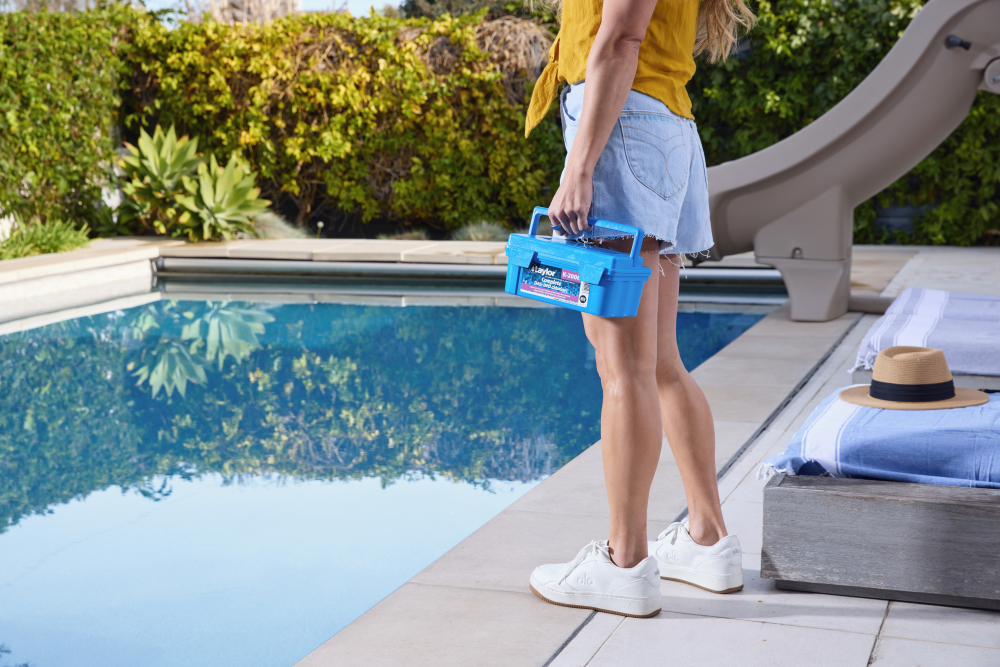
You’ve almost certainly experienced the euphoria of sliding into a crystal-clear pool on a hot summer afternoon or relaxing in a steaming hot tub after a long day. But the feeling just hits differently when it’s your own pool or spa. It’s crucial to keep that water clear and comfortable so you can chase that feeling whenever you’d like.
Pool and spa ownership does come with a little home maintenance. If you’re unsure how to test your pool or spa water, gaining that knowledge can help you maximize your experience. Water chemistry might sound intimidating, but once you master the basics, it becomes a simple, rewarding routine.
In this guide, we walk you through exactly what you’re testing for, how to choose between test strips and liquid test kits, and why millions of pool professionals and homeowners trust Taylor to protect their water investments.
Why Testing Your Water Matters
Clear water doesn’t guarantee clean water. Bacteria, contaminants, and unbalanced chemical levels are all invisible to the human eye and may be lurking underneath a sparkling surface. Failing to test and balance your water regularly can lead to:
- Skin and eye irritation for swimmers
- Cloudy, green, or musty-smelling water
- Costly structural damage, like etched plaster or corroded pool heaters
By committing to a regular testing schedule, you catch shifting chemistry levels early, saving time, money, and headaches.
If you’re not sure where to start, our how-to video can help.
What Do You Water Test For?
Sanitizer Levels (Bromine or Chlorine)
Sanitizers help protect your water from harmful bacteria and algae. Two of the most common sanitizers are bromine and chlorine. Bromine is more common in spas because it offers superior performance with higher bather loads and at higher temperatures. Chlorine is more common in pools due to its affordability and UV resistance. Whether you use chlorine tabs, liquid chlorine, or chlorine generated by a salt chlorinator, it's crucial to test regularly and understand that there are different types of chlorine to measure:
- Free Available Chlorine: The active sanitizer available to kill impurities.
- Combined Chlorine: Chlorine that has reacted with organic materials (this is what causes that strong chlorine smell).
- Total Chlorine: The sum of both free and combined chlorine.
While you should always check with your local pool professional to confirm the right ranges for your pool or spa, you’re typically looking for the following:*
Recommended Pool Free Available Chlorine Range: 2.0 – 4.0 ppm (Parts Per Million)
Recommended Pool Combined Chlorine: Less than 0.4 ppm
Recommended Pool Total Chlorine Range: 2.0 – 4.4 ppm
Recommended Spa Bromine Range: 3.0 – 5.0 ppm
Water Balance
In addition to sanitizer levels, your regular water testing routine should include testing for overall water balance. The Langelier Saturation Index (LSI) is a measurement of the water’s overall balance. Our digital LSI Calculator is one of the simplest ways to measure this crucial, but complex formula.
pH
pH measures how acidic or basic your water is on a scale from 0 to 14. If your pH climbs too high, your sanitizer loses its effectiveness, and scale can build up. If it drops too low, the water becomes acidic, irritating swimmers' skin and corroding equipment.
Ideal Range: 7.4 – 7.6
Total Alkalinity (TA)
Total Alkalinity is the buffering capacity of water to resist pH changes. It’s essentially a shield for your pool or spa’s pH. TA is a crucial indicator of your pool’s overall condition because it shows how resistant the water is to fluctuations known as “pH bounce.” Keeping TA in the ideal range ensures your pH stays in range.
Ideal Range: 80 – 120 ppm
Calcium Hardness
This measures the amount of dissolved calcium in your water. If calcium is too low, the water becomes aggressive and can actually leach minerals out of your pool walls and grout. If it’s too high, it leads to crusty, grayish-white scaling in your pipes and heater.
While total hardness measures both magnesium and calcium salts in your water, only calcium hardness is relevant for calculating your water balance.
Ideal Range (Pools): 200 – 400 ppm
Ideal Range (Spas): 150 – 250 ppm
Cyanuric Acid (CYA / Stabilizer)
Mainly used in outdoor pools, CYA acts as a sunblock for your free chlorine, protecting it from being depleted by UV rays.
Ideal Range: 30 – 50 ppm
Should I Use Test Strips or Liquid Test Kits?
When looking for the best pool and spa water testing options, you’ll generally have two primary water test methods: test strips and liquid drop test kits.
Pool & Spa Water Test Strips
Test strips are the fastest way to get an overview of your pool or spa health. You simply dip a strip into the water, wait a few seconds, and match the changing colors on the pad to the chart on the back of the bottle.
- Pros: Fast, easy for beginners, and highly affordable.
- Cons: Provide a generalized range rather than an exact, precise number. They can also be difficult to read if you have color vision deficiencies.
- Best for: Daily spot-checks or quick evaluations between heavy swim loads.
For quick, dependable answers, try the Taylor 7-Way Test Strips for Pools & Spas (SKU: S-1403) or the Taylor Chlorine Test Strips for Pools & Spas (SKU: S-1401).
Reagent Test Kits
Test kits require you to collect a water sample in a small plastic comparator block and add chemical drops known as reagents. The water changes color, and you either look for a specific color match or count the drops until the solution shifts from one color to another in a process called titration.
- Pros: Highly precise, professional-grade accuracy. They tell you exactly the right dosage of a chemical you need to add.
- Cons: Take a few minutes longer to run than a strip and require reading and following directions carefully.
- Best for: Your comprehensive weekly testing routine and diagnosing water issues.
The entry-level Taylor 3-Way Test Kit (SKU: K-1001) is perfect for basic daily care. For complete, gold-standard weekly maintenance, homeowners everywhere rely on the Taylor Complete™ Test Kit (FAS-DPD) (SKU: K-2006), which separates free and combined chlorine with exact drop-count accuracy.
How to Test Your Pool Water Like a Pro
No matter which method you choose, it’s important to follow best practices to get the most accurate results. This step-by-step process can help ensure quality results every time:
- Collect sample elbow-deep: With the test kit, don't collect your water sample near the surface, which is heavily affected by sunlight and air. Reach down about elbow-deep, away from any return jets or chemical feeders, to collect your sample.
- Watch the sun: Morning testing is usually ideal, before intense UV rays begin to break down the sanitizer levels in your water.
- Stay consistent: Test at roughly the same time every day. That’s not just for UV levels, but to account for other variables like cleaning, yard debris, and when you’re most actively using the pool or spa.
- Hold bottles vertically: When using a drop test kit, hold the reagent bottle completely upside down. Squeezing it at an angle alters the size of the drop, which can throw off your final calculation.
- Practice proper storage: Keep your test strips and reagents stored in a cool, dry place out of direct sunlight. Ensure lids are screwed on tightly after every single use to prevent contamination.
The Taylor Difference
For nearly a century, Taylor has been a ground-breaking leader in water analysis. The reason that pool service professionals everywhere trust Taylor is uncompromising accuracy.
When it comes to ensuring clean, healthy pool water for your family to enjoy, you can’t leave it up to guesswork. An inaccurate test could lead to money wasted on unnecessary chemicals, damaged equipment, or even health issues.
By choosing Taylor, you’re using the exact same chemical formulations trusted by local service professionals and Olympic-level facilities alike. We bring professional precision directly to your backyard, transforming pool maintenance from a guessing game into an easy science.
Get your Taylor test kit today.
* EPA-registered pool and/or spa sanitizers and systems with EPA-accepted labels indicating ranges outside of these recommended ranges must be used in accordance with the product manufacturer’s EPA-accepted label for use.